
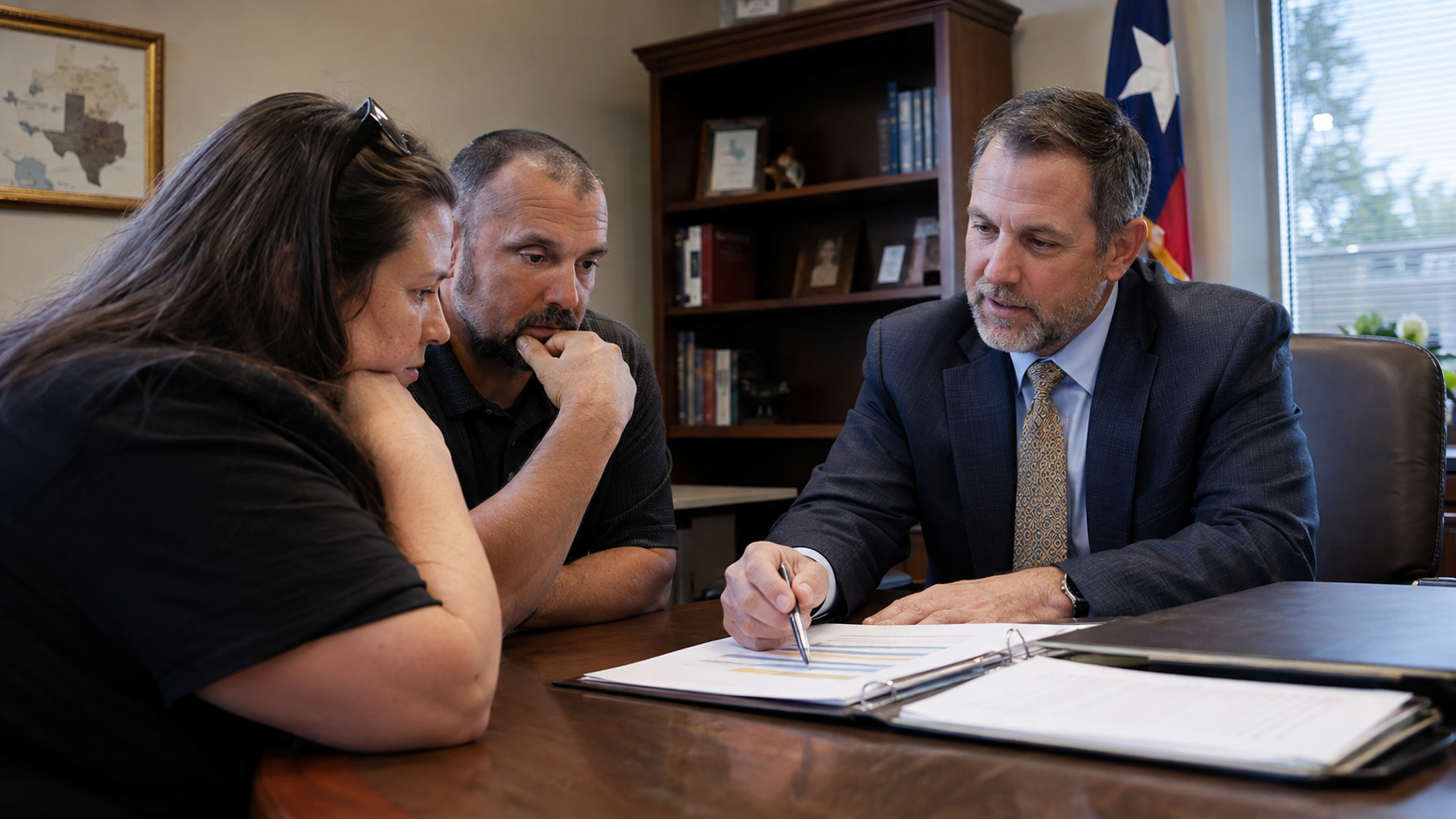

When someone you love becomes eligible for parole in Texas, it is natural to wonder whether your family needs a Texas parole attorney. Some families begin searching for a parole lawyer immediately, while others prepare letters and release information without legal representation.
Texas does not require an incarcerated person to have an attorney during the parole-review process. Hiring a lawyer also does not guarantee approval. Nevertheless, an experienced Texas parole attorney may help a family understand the process, identify problems, organize relevant information and avoid mistakes—particularly when a case is complicated or the review date is approaching.
The right time to consult a parole lawyer depends on the individual case, its history and the family’s ability to prepare reliable information.
How Texas parole review works
Texas parole review is generally a file-based process, not a courtroom hearing.
The TDCJ Parole Division identifies an incarcerated person approximately six months before an initial parole-eligibility date and approximately four months before a subsequent review. An Institutional Parole Officer interviews the person and prepares a case summary. The file is then forwarded to the designated Texas Board of Pardons and Paroles office.
A three-member parole panel reviews the case sequentially. Two matching votes produce the decision; if the first two voters disagree, the third voter breaks the tie. An approval may carry special conditions, while a denial identifies a future review date.
Because the decision is normally made from the record and submitted materials, accurate preparation can be important. Families should not expect a conventional hearing at which the incarcerated person and a Texas parole lawyer automatically appear before the entire panel. The Board’s current review guidance explains that interviews with incarcerated individuals and people supporting their release remain discretionary in most circumstances.
Is a Texas parole attorney required?
No. A family may send support information directly, and the Board does not require an attorney or a document formally called a “parole packet.”
This distinction matters because some businesses and individuals market paid parole services without being licensed lawyers. Under Texas Government Code Chapter 508, a person who represents an incarcerated individual for compensation before the Board, a parole panel or the Parole Division must be licensed to practice law in Texas and registered with the Parole Division.
The Texas Board of Pardons and Paroles advises families to verify those qualifications before paying for representation. The Board also makes clear that legal representation is not required merely to submit support information.
A Texas parole attorney should therefore be considered a professional resource—not a mandatory gatekeeper and never a guaranteed path to release.
When should a family consider consulting a parole lawyer?
1. The parole review period is approaching
Waiting until the Board has nearly finished voting may leave little time to investigate records, speak with the family and organize relevant information.
For an initial review, TDCJ generally begins assembling the case several months before the eligibility date. A family that wants legal advice should consider consulting a parole attorney before or near the beginning of that review window.
Hiring counsel years in advance may not be necessary in every case. However, an early consultation can help a family understand the timeline and determine what can realistically be accomplished before review.
2. The case involves a serious or complicated offense
The Board considers more than eligibility. Its published factors include the nature and seriousness of the offense, criminal history, previous periods of supervision, institutional conduct, program participation, age, sentence length and the amount of time served.
The Board’s parole guidelines combine an offense-severity classification with a risk assessment. Those guidelines inform—but do not control—the decision. Panel members retain discretion to vote outside the guideline recommendation. The official parole-guidelines explanation describes the relevant static and dynamic factors.
When the record is extensive, includes multiple cases or contains difficult facts, a Texas parole lawyer may help the family identify what must be acknowledged and which documented changes are genuinely relevant.
A responsible presentation should never minimize the harm caused by the offense or attack victims. It should address accountability, rehabilitation, risk reduction and a realistic plan for lawful reentry.
3. The incarcerated person has been denied parole before
A previous denial does not necessarily mean the next review will have the same result. It does, however, give the family information that should be studied.
Texas parole denials include coded reasons. Those explanations can be broad, and one denial code may contain several components that do not all apply to the individual case. A parole attorney can examine the available record, the denial reasons and developments since the previous review.
Relevant developments might include:
- Sustained disciplinary improvement
- Completion of education or treatment programs
- Greater insight into the offense
- A stronger housing plan
- Verified employment possibilities
- Improved family or community support
- A plan addressing substance-use, mental-health or medical needs
An attorney cannot erase unfavorable facts, but counsel may help explain what has changed and ensure that the presentation is supported by evidence rather than promises.
4. Important information may be inaccurate or incomplete
Families sometimes believe a TDCJ or parole record contains an error. A concern should be investigated carefully instead of assuming that a disappointing decision proves the file is wrong.
A Texas parole attorney may help identify available records, determine whether the suspected error is material and select the proper way to address it. This can be especially useful when names, cause numbers, criminal-history information, institutional records or release-plan details appear inconsistent.
Not every dispute will qualify for reconsideration, and a parole lawyer should not promise that the Board will reopen a decision.
5. The family expects significant opposition
The parole process allows victims, trial officials and other authorized individuals to provide information. Protest information can be important, and certain information may remain confidential.
A family should not attempt to contact or pressure a victim. When opposition is expected, legal guidance may help the incarcerated person’s supporters prepare a respectful presentation focused on accountability, rehabilitation, public safety and the proposed release plan.
The objective is not to argue that opposing voices should be ignored. It is to provide accurate information showing how identified risks would be managed if release were approved.
6. The release plan has weaknesses
A release plan is more than a proposed address. The Board’s official materials explain that planning may include:
- A stable residence
- Employment or a realistic employment strategy
- Transportation
- Treatment, counseling or recovery support when appropriate
- Financial and practical assistance
- Positive community and family support
- A plan for complying with supervision conditions
A parole lawyer may identify gaps, help the family document real commitments and remove vague or contradictory statements.
The strongest plan is truthful and workable. Families should not promise housing, employment or treatment that has not actually been discussed with the provider.
7. The family is unsure what to submit
The Board accepts support information without requiring a particular packet format. Its support-letter guidance says that letters may discuss employment, residence, transportation, treatment programs and other forms of support.
The Board also states that a few clear, concise letters are preferable to excessive petitions or repetitive submissions. More paper does not necessarily make a stronger case.
A Texas parole attorney may help decide what is relevant, organize it coherently and avoid submitting unsupported statements or unnecessary material.
8. The case involves special legal or procedural circumstances
Legal advice may be particularly valuable when the case involves:
- Consecutive sentences or multiple cause numbers
- Questions about eligibility calculations
- An approaching mandatory-supervision review
- Pending charges, detainers or holds
- Immigration consequences
- Prior parole or supervision revocations
- Sex-offense treatment requirements
- A serious medical condition
- Possible factual or procedural issues requiring specialized review
Some of these issues extend beyond ordinary parole preparation and may require counsel with additional criminal, appellate or immigration experience.
What can a Texas parole lawyer actually do?
The scope of representation varies, so families should ask the attorney to describe the work in writing.
Depending on the engagement, a parole attorney may:
- Review the sentence, offense history and prior parole results
- Explain the expected review process and timeline
- Interview the incarcerated person and family
- Review institutional conduct and program history
- Evaluate the proposed housing, employment and treatment plans
- Organize supporting records and letters
- Prepare a written presentation for the case file
- Submit authorized materials to the proper office
- Request a discretionary interview when appropriate
- Help the family interpret the eventual vote
An interview is not automatic. Under the Board’s policy effective September 1, 2025, a discretionary interview granted to someone presenting information on behalf of an incarcerated person is limited to 20 minutes. The Board also says that receiving an interview does not itself increase the likelihood of parole. See the current interview policy.
What a parole attorney cannot promise
No ethical Texas parole lawyer can truthfully guarantee:
- Parole approval
- A particular vote
- A specific release date
- An interview with a panel member
- The removal of accurate unfavorable information
- Special influence over Board members
- A result based solely on the size or appearance of a parole packet
The Board retains discretion, and even an approval vote may include conditions or program requirements. The Board may also reconsider an approval if it receives significant new information.
Families should be cautious when someone claims to have personal influence with the Board or promises a particular outcome.
Questions to ask before hiring a Texas parole attorney
- Are you licensed to practice law in Texas?
- Are you registered with the TDCJ Parole Division for compensated representation?
- How much of your practice involves Texas parole matters?
- What work is included in the quoted fee?
- Who will communicate with our family and the incarcerated person?
- Will you review prior denial reasons and institutional records?
- Will you help evaluate the release plan?
- What documents do you need from us?
- When will materials be submitted?
- Will you request a panel-member interview, and is that included in the fee?
- What happens if the Board votes before the work is completed?
- What promises are you unwilling to make about the outcome?
The attorney should explain both the potential value and the limitations of representation.
Families can use the State Bar of Texas public resources to review an attorney’s license status and public disciplinary history.
When a family may be able to proceed without an attorney
A family might reasonably prepare its own support submission when:
- The case is relatively straightforward
- The release plan is stable and well documented
- Family members can write clear, truthful letters
- There are no suspected record errors
- The family understands the review timeline
- There are no unusual legal or procedural issues
Proceeding without counsel does not mean doing nothing. The family should still confirm the review status, prepare a realistic release plan, submit concise information to the proper office and retain copies.
The best time to ask for advice
There is no universal date on which every family should hire a parole attorney. As a practical matter, the best time to seek an initial consultation is early enough for the lawyer to perform meaningful work before the panel reviews the case.
For many families, that means consulting a Texas parole lawyer several months before the anticipated review—not waiting until a decision is imminent. More complicated cases may justify earlier planning, while straightforward cases may not require full representation at all.
A consultation should help the family make an informed choice. It should never be based on fear, pressure or a promise that money can purchase parole.
Final thoughts
A Texas parole attorney can help a family understand the process, evaluate weaknesses and present relevant information in an organized manner. The attorney’s role is preparation and advocacy—not control over the Board’s decision.
Before hiring anyone, verify that the person is a licensed Texas attorney, clarify the services and fee, and reject guarantees. Whether the family hires a lawyer or proceeds independently, the submission should remain truthful, concise, documented and focused on accountability, rehabilitation, public safety and a realistic release plan.
This article provides general information about the Texas parole process and is not legal advice. Parole cases are fact-specific. Families seeking advice about an individual case should consult a qualified Texas attorney.